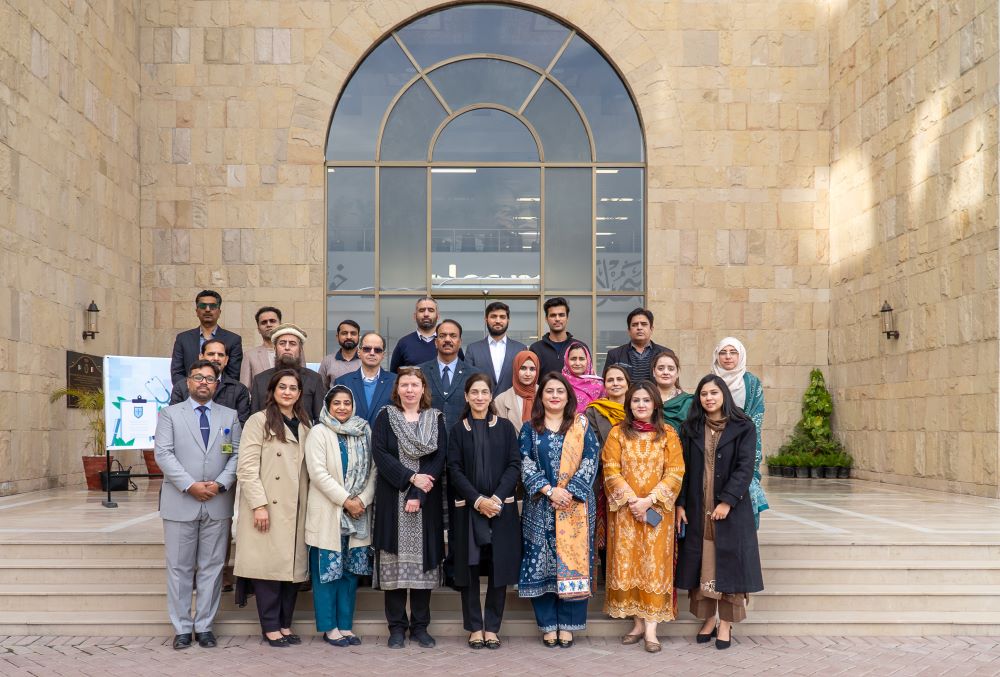
The NUMS Department of Public Health successfully conducted a five-day face-to-face contact session for Certificate in Healthcare Quality and Patient Safety (CHQPS) Batch II (2026) from 9–13 February 2026 at KHINAMS (0845–1600 hrs daily). The participants including clinicians, healthcare administrators, and nursing staff from various public and private sector health institutions across Pakistan actively attended the sessions
CHQPS is a six-month specialized certificate program designed to strengthen competencies in healthcare quality improvement and patient safety. The course emphasizes leadership, interprofessional collaboration, clinical governance, regulatory frameworks, and evidence-based quality enhancement strategies.
Day 1: Inaugural Session and Foundations of Patient Safety
The session commenced with a welcome note by Prof. Dr. Uzma Hassan, Head of the Department of Public Health, followed by participant introductions and a course overview by Dr. Tamkeen Jaffry and Dr. Nasir Javed. Brig. Dr. Ambreen Sohail, Chief Operating Officer, KHINAMS, and Prof. Dr. Aisha Mohyuddin, Dean of Multidisciplinary Studies, shared their remarks, encouraging participants to engage actively in the learning process.
Dr. Mati ur Rehman (Dean Allied Health Sciences, Health Services Academy) delivered an in-depth lecture highlighting human factors, certification, regulation, and high-reliability care systems. Later, Dr. Salwa Ahsan, Chief Pharmaceutical Officer at Shifa International Hospital, emphasized medication safety as a critical pillar of quality healthcare delivery.
Day 2: Health Systems and Global Perspectives
Prof. Dr. Baber Tasneem Sheikh (Dean, School of Public Health, Health Services Academy) addressed health system responsiveness as a key determinant of patient safety outcomes. Maj Gen Muhammad Aleem (Retd) discussed evidence-based strategies for continuous quality improvement within hospital settings. Ms. Afifa Baloch, Infection Prevention and Control Officer at the World Health Organization, presented WHO’s strategic role in strengthening patient safety initiatives in Pakistan.
Day 3: Accountability, Measurement, and Continuous Quality Improvement
Dr. Yasir Shahzad (Manager Quality, Riphah Health Directorate) explored accountability mechanisms, quality review processes, and reporting of adverse events. Dr. Nabeel Alvi (Director Quality, PNS Hafeez) conducted sessions on practitioner performance evaluation and professional accountability, followed by a hands-on activity on Continuous Quality Improvement (CQI) using PDSA cycles and Team STEPPS tools.
Day 4: Field Study Experience
Participants visited the Islamabad Health Regulatory Authority to gain practical exposure to healthcare regulatory and quality assurance mechanisms. The Visit to the Pakistan Air Force Hospital in Islamabad provided valuable real-world insights into the implementation of patient safety standards and quality frameworks.
Day 5: Data, Leadership, and Change Management
Dr. Rubab Farooqi, Assistant Professor of Public Health, NUMS, delivered a session on data analytics in healthcare quality. Dr. Babar Saeed Khan, Director Clinical Trial Unit, NUMS, discussed leadership and stakeholder engagement in change management, linking strategy to practical implementation.
In the concluding remarks, Associate Professor Dr. Tamkeen Jaffry expressed sincere gratitude to Prof. Dr. Uzma Hassan for her leadership and continued support, and praised the efforts of Coordinator of Program Dr. Nasir Javed, Assistant Professor Dr. Raima Asif, Assistant Professor Dr. Rubab Farooqi, Lecturer Ms. Rubab Zulfiqar and Office Assistant Hafiz Zeeshan Hussain for ensuring the seamless conduction of all activities. The participants highly appreciated the excellent arrangements of the session and commended the program for its relevance, practical approach, and insightful expert-led discussions.
.jpg)
.jpg)
.jpg)
.jpg)
.jpg)